Gas Technician Programs at Ontario Colleges
See how gas technician training is structured across Ontario colleges, ranked on an independent six-criteria score.
Compare Gas Technician programs in Ontario. Understand TSSA G3, G2 and G1 certification, the apprenticeship pathway, and how to choose the right Ontario college.
| Rank | College | Location | Score | Reviews |
|---|---|---|---|---|
| 1 |  Hi-Mark Occupational Skills Training Centre is a Canadian-owned private career college (operating since 1995) specializing in HVAC and gas technician certification. Registered under Ontario's Private Career Colleges Act 2005 and accredited by the Technical Standards and Safety Authority (TSSA), it offers G3, G2, and G1 gas technician training plus HVAC fundamentals. A distinctive co-op model alternates one week of in-class training with one week of paid field placement. Toronto | Toronto | 7 /10 | No reviews yet |
| 2 |  Herzing College is a registered private career college whose Toronto Skilled Trades campus is an approved training facility of Merit Ontario and the CLAC Union. It offers pre-apprenticeship programs in carpentry, electrician, and plumbing, plus Gas Technician 3 and 2 certification, network cabling, and construction management. Programs are hands-on with in-house workshops and union employer connections that help graduates line up work. Toronto | Toronto | 7 /10 | No reviews yet |
About gas technician programs in Ontario
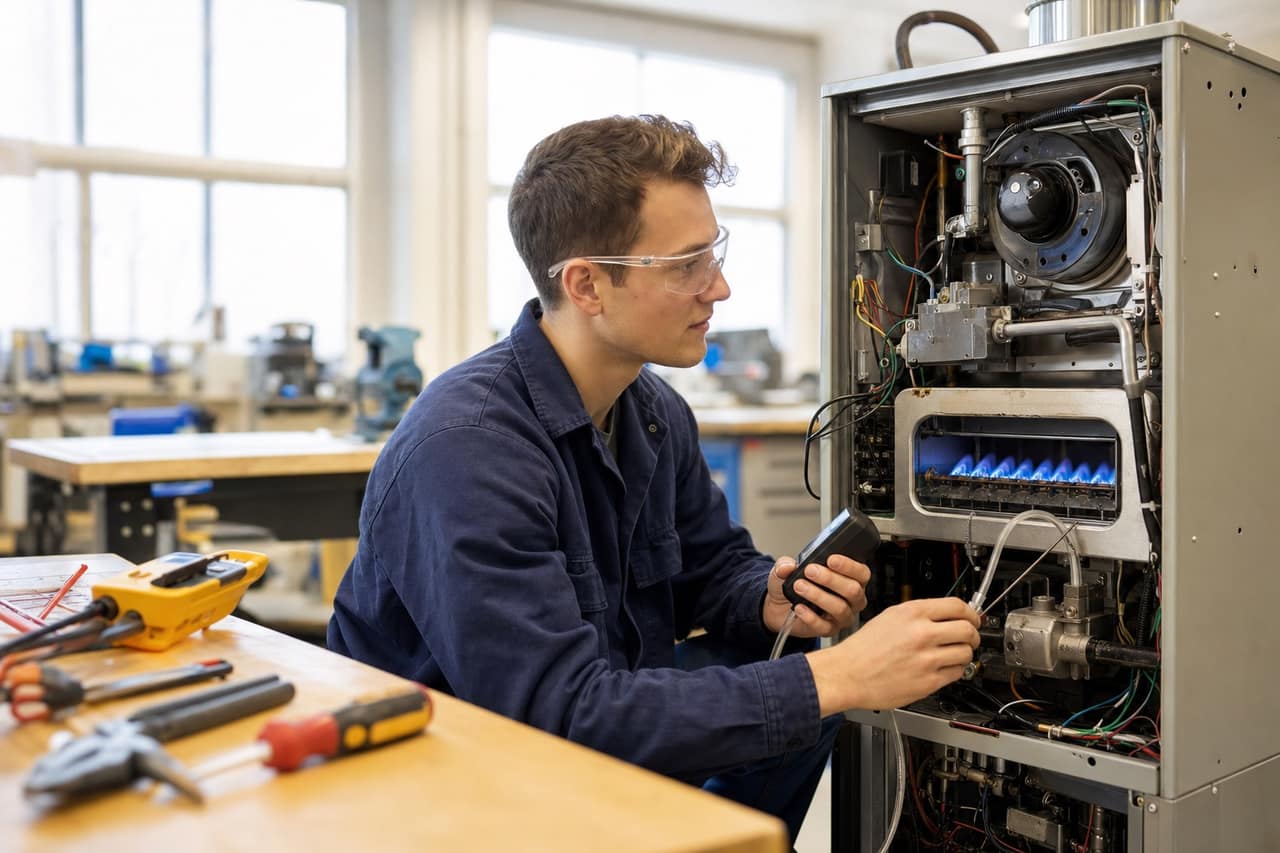
Gas Technician programs in Ontario prepare you to install, service, and inspect natural gas and propane appliances and systems — from furnaces and water heaters to commercial equipment. Gas work in Ontario is regulated by the Technical Standards and Safety Authority (TSSA), which sets the certification levels you must earn before you can legally work on gas equipment. This page helps prospective students compare Ontario colleges that offer Gas Technician training and understand the certification path. We're an independent directory — we don't run the programs, so always confirm current details on each college's profile.
What you'll learn
Gas Technician training combines in-class theory with hands-on practical work. Coverage builds across the certification levels and commonly includes:
- Gas safety, codes, and TSSA regulations
- Properties and safe handling of natural gas and propane
- Combustion, venting, and appliance operation
- Wiring and controls for gas appliances
- Installing, servicing, and troubleshooting furnaces and water heaters
- Piping, sizing, and pressure testing
Specific course content, equipment, and how lab time is balanced vary by college — see each college's profile.
Apprenticeship & certification
In Ontario, gas certification is structured in three TSSA levels, earned in sequence:
- G3 — entry-level certificate covering foundational knowledge and lower-input appliances.
- G2 — expands the range and capacity of equipment you're authorized to work on.
- G1 — the most advanced certificate, covering the broadest scope of gas work.
Many students pair training with the Gas Technician apprenticeship, administered in Ontario through Skilled Trades Ontario, which blends on-the-job hours with in-class learning.
Pre-apprenticeship vs. apprenticeship
- Pre-apprenticeship programs help newcomers build foundational skills and prepare for an apprenticeship or entry-level certification.
- Apprenticeship streams pair paid on-the-job training with classroom sessions through a sponsoring employer.
Whether a college offers a pre-apprenticeship stream, apprenticeship-aligned training, or standalone G3/G2 courses varies — check each profile.
Career paths
Certified gas technicians work across residential, commercial, and industrial settings — as gas appliance service technicians, furnace and heating installers, and propane systems technicians. Because gas work overlaps with HVAC, many technicians hold complementary credentials.
How to choose a college
When comparing Ontario colleges, look at which certification levels (G3, G2, G1) a program prepares you for, whether it's pre-apprenticeship, apprenticeship, or standalone, hands-on lab access, location and intake dates, and financial-aid options. Costs, durations, and schedules vary by college — compare profiles and contact schools directly before you apply.
Frequently asked questions
What does a Gas Technician do in Ontario?
A Gas Technician installs, services, inspects, and repairs natural gas and propane appliances and systems — such as furnaces, water heaters, and commercial equipment. In Ontario, this work is regulated by the Technical Standards and Safety Authority (TSSA), and you must hold the appropriate certification before working on gas equipment.
What are the G3, G2, and G1 certification levels?
Ontario's TSSA gas certification has three levels earned in sequence. G3 is the entry-level certificate covering foundational knowledge and lower-input appliances. G2 expands the range and capacity of equipment you can work on. G1 is the most advanced certificate, covering the broadest scope of gas work. Most students start at G3 and progress upward.
Do I need an apprenticeship to become a Gas Technician?
Many people combine TSSA certification with the Gas Technician apprenticeship, which is administered in Ontario through Skilled Trades Ontario and blends on-the-job hours with in-class learning. Some colleges also offer standalone G3 or G2 courses and pre-apprenticeship programs. The exact pathway varies by college — check each college's profile for what it offers.
What's the difference between a pre-apprenticeship and an apprenticeship?
Pre-apprenticeship programs help newcomers build foundational skills and prepare for an apprenticeship or entry-level certification, often without a sponsoring employer. An apprenticeship pairs paid on-the-job training under an employer with periods of in-class instruction. Whether a college offers either stream for gas work varies — confirm on the college's profile.
How much do Gas Technician programs in Ontario cost, and how long do they take?
Tuition, program length, and schedules vary by college and by which certification levels a program covers. Because this is an independent directory, we don't set those details — compare each college's profile and contact the school directly for current cost, duration, and intake information.
Is Gas Technician a Red Seal trade?
Gas work in Ontario is governed primarily through TSSA certification (G3, G2, G1) rather than a Red Seal gas-technician endorsement. Some related trades carry Red Seal endorsement, and many technicians hold complementary HVAC credentials. For the credentials a specific program leads to, see each college's profile.
Still have questions? Contact us.