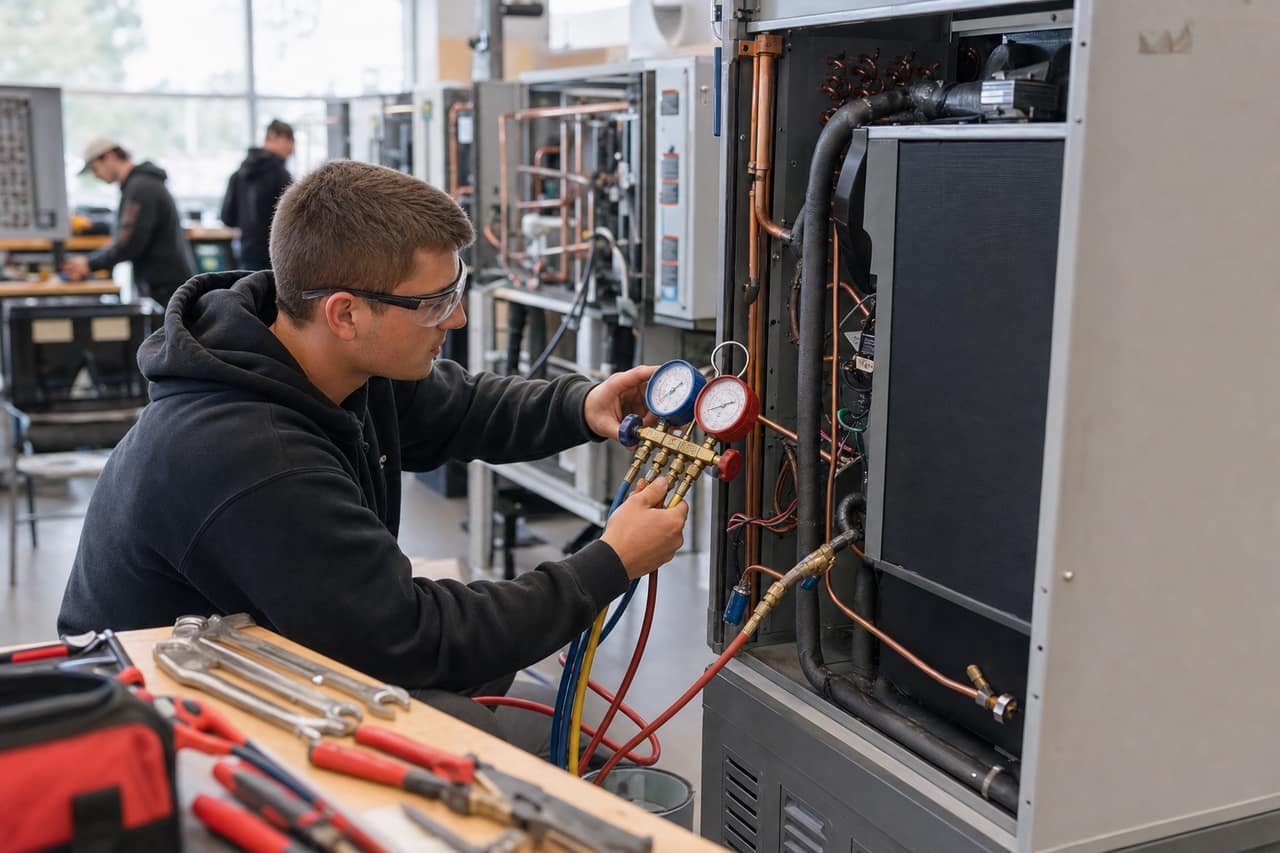
HVAC Programs at Ontario Colleges
See how HVAC training is structured across Ontario colleges, ranked on an independent six-criteria score.
Compare Ontario colleges offering HVAC programs and apprenticeships — heating, ventilation, air conditioning and refrigeration. See pre-apprenticeship and apprenticeship pathways, gas (TSSA), and Red Seal options.
| Rank | College | Location | Score | Reviews |
|---|---|---|---|---|
| 1 |  Skilled Trades College of Canada 1
Top Rated
Skilled Trades College of Canada (STC) is a private trades-training college with six campuses across Toronto and the GTA. It offers condensed 12-week pre-apprenticeship programs in electrical, plumbing, HVAC, and home renovation, delivered as 80% hands-on learning in lab-based simulated work environments with small class sizes. STC bundles a full professional tool kit, PPE, and industry safety certifications into every program to graduate job-ready apprentices, and has trained over 1,000 students. Woodbridge | Woodbridge | 9.4 /10 | No reviews yet |
| 2 |  Humber Polytechnic is a publicly funded Ontario college (established 1967, rebranded from Humber College in 2024) offering apprenticeship and pre-apprenticeship training in the skilled trades. Its Centre for Skilled Trades and Technology at Carrier Drive features a 2024 expansion with new HVAC, gas/oil, AR/VR/XR and woodworking labs designed like an actual worksite. Programs span construction and maintenance electrician, plumber, carpenter, millwright, welder, and arborist trades. Toronto | Toronto | 7.5 /10 | No reviews yet |
| 3 |  Centennial College is a publicly funded Ontario college (established 1966) recognized for its automotive and motive power trades, including manufacturer-specific Modified Apprenticeship Programs (MAPs) with Ford, Honda, GM, and Toyota. Skilled trades training spans automotive service technician, truck and coach technician, heavy equipment technician, construction and maintenance electrician, and HRAC to Red Seal standards. Programs are delivered with access to simulation labs at the Progress Campus. Toronto | Toronto | 7.3 /10 | No reviews yet |
| 4 |  Seneca Polytechnic is a publicly funded Ontario college (established 1967, rebranded from Seneca College in 2023) offering trades-adjacent technology programs that complement apprenticeship and industrial maintenance careers. Credentials include Electromechanical, Mechanical, and Civil Engineering Technology plus HVAC Technology, delivered with strong employer co-op networks across the GTA. Its Newnham campus in North York anchors most technology programming. North York | North York | 7.1 /10 | No reviews yet |
| 5 |  Hi-Mark Occupational Skills Training Centre is a Canadian-owned private career college (operating since 1995) specializing in HVAC and gas technician certification. Registered under Ontario's Private Career Colleges Act 2005 and accredited by the Technical Standards and Safety Authority (TSSA), it offers G3, G2, and G1 gas technician training plus HVAC fundamentals. A distinctive co-op model alternates one week of in-class training with one week of paid field placement. Toronto | Toronto | 7 /10 | No reviews yet |
About HVAC programs in Ontario
HVAC (heating, ventilation, air conditioning and refrigeration) keeps Ontario's homes, hospitals, schools and commercial buildings comfortable and safe year-round, and it remains an in-demand skilled trade. Because the work spans furnaces, ductwork, cooling and refrigeration — and overlaps with regulated gas work — HVAC programs can lead in several directions. This page helps you compare Ontario colleges that offer HVAC training and find the pathway that fits your goals.
What you'll learn
HVAC programs typically blend hands-on shop practice with classroom theory. Curriculum, equipment and scheduling vary by college, so review each college's profile for specifics. Common areas of focus include:
- Heating systems — furnaces, boilers and forced-air systems
- Cooling and air conditioning — installation, servicing and troubleshooting
- Refrigeration — commercial and residential refrigeration cycles
- Ventilation and ductwork — airflow, sheet metal and indoor air quality
- Electrical and controls — wiring, thermostats and diagnostics
- Safety and codes — workplace safety and the regulations governing the trade
Apprenticeship and certification
In Ontario, the skilled-trades apprenticeship system is administered through Skilled Trades Ontario. Training combines in-class learning at a college or training provider with paid on-the-job learning under a qualified employer.
Pre-apprenticeship vs. apprenticeship
- Pre-apprenticeship programs help people new to the trade build foundational skills and prepare to find a sponsoring employer.
- Apprenticeship streams alternate paid on-the-job hours with periodic in-class sessions, working toward certification.
Several HVAC-related trades carry a Red Seal endorsement, which supports recognition across participating provinces and territories.
Gas work and TSSA
Much HVAC work involves natural gas and propane appliances, which are regulated in Ontario by the Technical Standards and Safety Authority (TSSA). Gas technician certification follows graduated levels — G3, then G2, then G1 — each expanding the scope of gas work you're authorized to perform. HVAC training often overlaps with the 313A (refrigeration and air conditioning systems mechanic) and 313D (residential air conditioning systems mechanic) trades.
How to choose a college
- Hands-on facilities — labs, live equipment and shop time
- Certification alignment — Red Seal, 313A/313D and gas (TSSA) preparation
- Stream fit — pre-apprenticeship vs. apprenticeship
- Employer connections — co-op, placement support and partnerships
- Location and schedule — campus, format and start dates
Use this directory to compare Ontario colleges side by side, then visit each profile for details.
Frequently asked questions
What is the difference between a pre-apprenticeship and an HVAC apprenticeship in Ontario?
A pre-apprenticeship program is designed to help people new to the trade build foundational skills and prepare to secure a sponsoring employer. An apprenticeship combines paid on-the-job learning under a qualified employer with periodic in-class training, working toward certification. Ontario apprenticeships are administered through Skilled Trades Ontario. The exact structure and entry requirements vary by college — see each college's profile for details.
Do I need a gas licence to work in HVAC in Ontario?
Gas work in Ontario is regulated by the Technical Standards and Safety Authority (TSSA), which oversees gas technician certification through graduated levels — G3, then G2, then G1 — each expanding the scope of gas appliances you're authorized to work on. Because much HVAC work involves natural gas and propane equipment, many students pursue gas certification alongside their HVAC training. Whether a specific program prepares you for gas certification varies by college.
Is HVAC a Red Seal trade?
Several HVAC-related trades in Ontario carry a Red Seal endorsement, which supports recognition of your qualification across participating provinces and territories. Related certified trades include 313A (refrigeration and air conditioning systems mechanic) and 313D (residential air conditioning systems mechanic). Confirm which certifications a given program supports by reviewing each college's profile.
What do HVAC programs in Ontario teach?
HVAC programs typically combine hands-on shop practice with classroom theory, covering heating systems, air conditioning and cooling, refrigeration, ventilation and ductwork, electrical controls and diagnostics, plus safety and the codes governing the trade. Specific curriculum, equipment and lab facilities vary by college, so review each college's profile to compare what's offered.
How do I choose the right Ontario college for HVAC?
Compare colleges on their hands-on facilities and shop time, how their training aligns with certifications like Red Seal, 313A/313D and gas (TSSA), whether they offer the stream you want (pre-apprenticeship or apprenticeship), their employer and placement connections, and practical factors like campus location, format and start dates. This directory lets you compare Ontario colleges side by side before visiting individual profiles.
What jobs can HVAC training lead to in Ontario?
HVAC training can lead to roles in residential service, commercial and institutional mechanical work, refrigeration, building controls and energy efficiency. Specific roles, demand and how you progress depend on your certifications, experience and the employer. Review individual college profiles and current Ontario labour-market information for the most accurate, up-to-date picture.
Still have questions? Contact us.